
Split, Croatia: More Than the Sum of Its Parts


Carla and I have now been in Split, Croatia, for three weeks, with one more week still to go. We decided to spend a full month here because Split had caught our attention in a different way than most places do. We were not just coming to visit. We were coming to see what it might feel like to actually live here.
From blogs we had read, YouTube videos we had watched, and conversations with other people, Split seemed like it might be more than just a good place to spend a few days. It seemed like it might actually work as a temporary home, maybe even for a year. So we arrived looking at it through a different lens. We were not only asking, do we enjoy this place? We were also asking, could this feel like home?

What we discovered is that Split is, in a very real way, more than the sum of its parts. In that sense, it reminded me of The Beatles. Like a lot of people my age, I am a huge Beatles fan. Each of them was enormously gifted in his own right, and their solo careers make that clear. But when they came together, something happened that was greater than the sum of those individual talents. On a scale of one to ten, even if each of the four Beatles was a ten on his own, together they somehow became a fifty. That is a little like how Split landed with me.
Because when I look at its individual parts, I am not necessarily blown away. The coastline is nice, but not spectacular. That may be a little unfair given what we have seen on this trip. We have recently spent time in places like Kotor, Montenegro, and Fethiye, Kaş, and Antalya in Turkey, all of them places with dramatic coastlines where mountains rise right out of the sea in almost impossibly beautiful ways. Compared to places like those, Split’s waterfront feels more ordinary.

The old town is more interesting than stunning. It is built within The Palace of the Roman Emperor Diocletian, which is historically fascinating and quite unusual. There is something genuinely compelling about a city that has grown up inside the remains of an ancient Roman palace. But maybe because we have now seen so many old towns in Europe, it did not immediately strike us as one of the most beautiful or unforgettable. And yet, somehow, it all comes together to create a city that feels far more inviting, enjoyable, and livable than those individual parts might suggest. That is what surprised us. Split did not hit us with obvious beauty or instant charm. Instead, it worked on us slowly. The longer we were here, the more it revealed itself.

Part of that comes from the way life unfolds here. The Riva, Split’s palm tree-lined promenade, feels like the city’s living room. It is always full of people walking, talking, lingering over coffee, or simply sitting by the water and watching the day pass. The stone streets in and around Diocletian’s Palace do not feel frozen in history. They feel woven into everyday life. History and daily life sit right beside each other here. There is energy, but it rarely feels rushed or overwhelming. It feels human, warm, and easy to live in.
Sometimes visiting a place is a little like falling in love. You arrive and are immediately swept away. Everything feels magical. But then, as time goes on, the shine softens and you begin to see the place more honestly. We have definitely had that experience before. But Split was almost the opposite.

When we first arrived, my feeling was that I liked it. I did not love it. I was not dazzled by it. But instead of that feeling fading, it grew. The longer we stayed, the more we appreciated the city and the more we understood why so many people are drawn to it, not just as a place to visit, but as a place to live. And that matters.
If you are looking at a place through the lens of living there, being instantly swept away may not be the most important thing. A place that grows on you can, in some ways, be more promising than one that dazzles you right away and then slowly loses its hold. Split has that kind of quiet appeal. It does not shout. But over time, it makes its case.
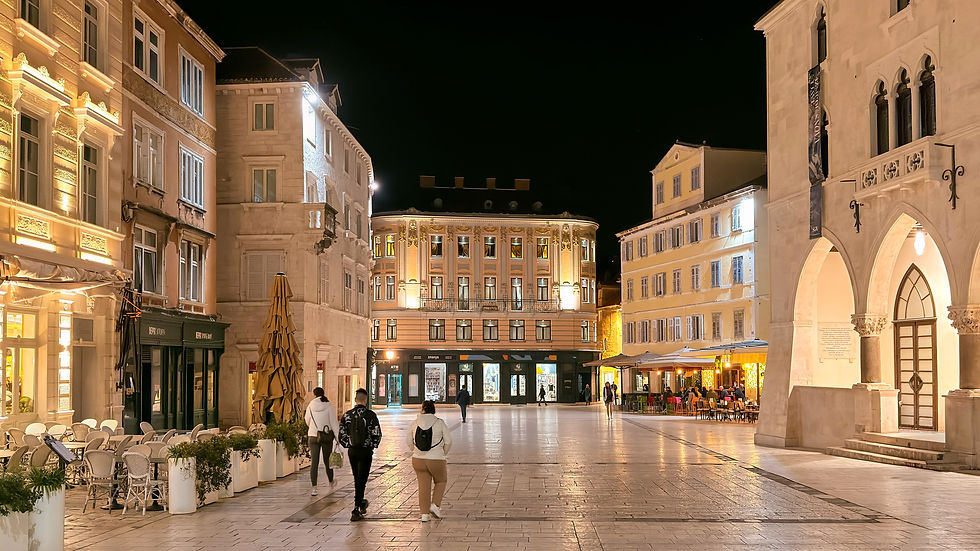
It also has something that matters just as much as beauty, maybe even more. It has an inviting feel. It is easy to feel at home here. The people have been friendly. The city has energy without feeling overwhelming. The promenade is lively and full of life. There is always something happening, always people out walking, sitting, talking, eating, and meeting. We even went to an expat meetup and found the group to be diverse, interesting, and very welcoming. If you are imagining life in a place rather than simply passing through it, those things count for a lot.
So I will not wait until the very end to answer the question we came here with. Will Split be our landing place?
It will not.
But that is not a knock on Split. Not at all. That has much more to do with Carla and me than with the city itself. Whenever we look at a place as a possible home, we have our checklist, just as most people do. And we are realistic enough to know that no place is going to check every box. But for us, one question matters more than the others: did we truly connect with the place?

And while we thoroughly enjoyed our time in Split, we also realized that we were not quite smitten enough to call it our next home. That is really what it comes down to. We liked Split. We can absolutely see why others would choose it. But for us, the connection was not quite deep enough. There was not quite enough pull. Not quite enough of that feeling that says, yes, this is it.
Still, I am very glad we tried it on. That is part of this process too. Every place we consider teaches us something. It teaches us more about what we are really looking for, and more about ourselves. Sometimes a place confirms our hopes. Sometimes it gently clarifies them. And that too is valuable.

So regardless of our decision, if you asked me whether I think Split is worth visiting, my answer would be easy.
Absolutely.
Not only is it enjoyable to visit, it has that added quality that makes it even better: it feels livable. Even if you have no intention of moving abroad, there is something about being in a city that feels genuinely workable as a daily life kind of place that deepens the experience of being there. It makes the visit feel a little less like tourism and a little more like a glimpse into real life.

That, to me, is one of Split’s real strengths. It may not dazzle you in every individual way, but somehow it all comes together into a place that feels warmer, easier, and more appealing than those individual parts would suggest.
Like I said, it reminds me of The Beatles. The whole is greater than the sum of its parts. And Split, for us, turned out to be exactly that kind of place.

We loved Split. Had the best olive oil I have ever tasted there! Stayed in a tiny hotel inside Old Town.
Thanks for sharinig...Split is one of our favorite cities, and your blog brought back some good memories. Glad you have enjoyed your time there!
Wow. Sounds absolutely beautiful. I have to wonder if, now after all your travels so far, moving/traveling has in fact become "home." thoughts?