
Seeing the Extraordinary in the Ordinary


One of my greatest joys is photographing the places we visit. That probably comes as no surprise to those of you who have followed Carla and me as we have wandered over these past four years. I have been anything but shy about sharing my photos on Facebook, Instagram, and here on the blog, and I love this way of sharing our travels with others.
I am deeply grateful for how warmly my photography has been received. It means a lot when people tell me they have enjoyed seeing a place through my eyes. It means even more when someone says my photos helped them decide to visit somewhere they had not considered before, and I love that.

Of course, when that happens, I also feel a little nervous. If someone chooses to visit a place because of my photos, I suddenly feel a strange sense of responsibility. What if they do not love it as much as we did? What if the light is different, the weather is different, or the place lands differently for them? Even with that, it has been one of the great pleasures of this chapter of life to share what I am seeing and feeling as I move through the world.
At seventy-two years old, I am incredibly grateful to still feel that I am living a purpose-driven life. That matters to me. For me, purpose has always been tied to some form of creative engagement with life. I need to feel that I am not only passing through places, but paying attention to them. I need to feel that I am taking something in, responding to it, and finding some way to share it. Photography and writing have given me that, and together they have made this stage of life richer than I ever could have imagined.

But perhaps the greatest gift photography has given me is something I can only describe as the art of seeing.
I do not mean simply seeing in the ordinary sense. We all see what is in front of us, at least on the surface. We see the street, the buildings, the sea, the cafe, the church, the tree, the old woman in the doorway, the child chasing a ball, the laundry hanging from a balcony. But photography has taught me that there is seeing, and then there is really seeing. There is glancing at the world as we move through it, and then there is allowing the world to come closer.
That distinction has become one of the quiet revelations of our travels. When Carla and I arrive in a new place, my natural impulse is to begin taking pictures almost immediately. There is the excitement of newness, the pull of unfamiliar streets, the first encounter with a harbor, an old town, a mountain view, a café corner, or a certain kind of light. My shutter finger can get restless very quickly.

But there is a problem with that. If I disappear too quickly into photography, I risk turning Carla into what I jokingly think of as a photographer’s widow. I may be physically walking beside her, but my attention is somewhere else. I am looking for angles, light, reflections, details, and compositions. I am stopping every few steps. I am inside my own creative bubble, and that is not the same as exploring a place together.
For both of us, one of the deepest joys of our travels is the shared experience of newness. We love arriving somewhere and taking it in together. We love those first walks when neither of us knows what is around the next corner, when every street feels like an invitation, and when we are both seeing something for the first time at the same time. That shared discovery is part of the intimacy of our life now. It is part of what makes travel feel so alive.

So we came up with an arrangement that has worked beautifully for us. When we first arrive in a new place, I usually do not take photos for the first couple of days. Carla and I simply walk. We explore. We get oriented. We let the place come to us without my constantly stopping to frame it.
Because we slow travel, this is easy enough to do. We are rarely in a place for only a day or two, so I can afford to wait. I can let the camera stay quiet for a little while and give myself over to the shared experience first, knowing that the photography will come later.

What surprised me, though, is that this little arrangement came with an unexpected gift. During those first walks with Carla, when I was not actually taking pictures, I began to notice that I was still seeing like a photographer. I was watching light move across walls, noticing the color of a door against an old stone building, the curve of a narrow street, the way a person’s red jacket changed the whole feeling of a gray alley, the pattern of chairs outside a cafe, or the shadow of a balcony falling across a weathered wall.
I was not trying to sneak in photography when I had promised not to. I was not secretly working. I was simply walking with Carla and taking in the place with her, yet something had changed in the way I was paying attention. It was as if I were photographing the walk without taking a single photograph.

That may sound a little strange, but it has become one of the most powerful parts of the whole experience for me. I began to realize that photography had changed not only what I do with a camera in my hand, but how I move through the world even when I am not holding one.
The simplest way I can say it is this: photography has taught me to see the extraordinary in the ordinary. And what a gift that has been.

There is a kind of transformation that happens when I am preparing to take a photograph. I may be looking at something very simple: a doorway, a table, a fishing boat, a cluster of flowers, light falling on a wall, an old man sitting alone with his coffee. Nothing dramatic. Nothing that would necessarily stop everyone in their tracks. But when I pause and look through the lens, the ordinary begins to reveal itself differently.
It is as though my eyes are no longer working alone. My heart comes into it. My soul comes into it. My attention deepens. I am no longer just looking at the thing in front of me; I am entering into some kind of quiet conversation with it.

That may sound dramatic, but anyone who loves photography, or really any creative practice, may understand what I mean. There are moments when the act of looking becomes more than looking. It becomes a form of listening, a form of prayer, a meditation without the cushion, the incense, or the quiet room.
The camera narrows the frame, but somehow widens the experience. That is one of the paradoxes I love most. When I look through the lens of my phone, I am focusing on a smaller slice of life than I would normally see with my full field of vision. The frame excludes almost everything else, and yet, somehow, my seeing feels wider. Or maybe deeper is the better word. I notice more. I feel more. I become more present.

A scene I might have walked past without much thought suddenly becomes rich with meaning. The peeling paint on a door is no longer just peeling paint. It becomes texture, age, weather, history, color, imperfection, and beauty. A chair outside a cafe is no longer just a chair. It becomes an invitation, a suggestion of human presence, a reminder that someone sat there, or will sit there, or has made that little corner part of daily life.
Photography has shown me again and again that there is almost always more happening than we first notice.
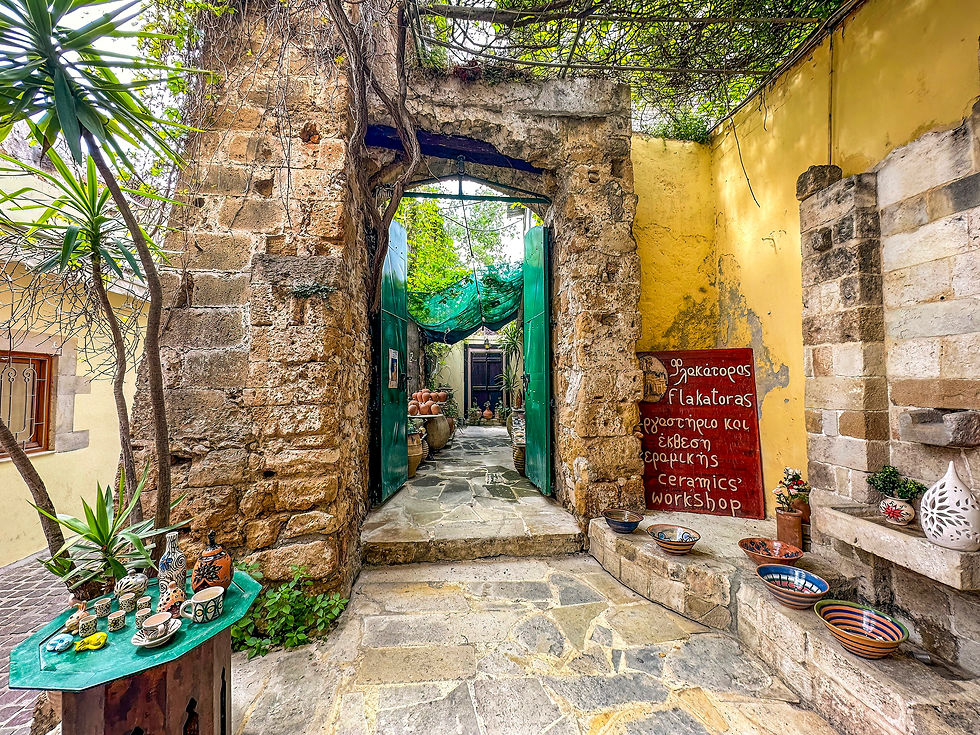
At first, I thought photography was something I did after I saw something beautiful. I saw the beauty, then I took the picture. But over time, I have come to understand that photography teaches me how to find beauty. It teaches me how to notice, how to look again, and sometimes to look one more time after that, because the first glance is rarely the whole story.
This has changed the way I walk through a place. It has changed the way I travel. It has changed the way I experience ordinary mornings with Carla as we wander through a town we have just arrived in. Even without a camera in my hand, I find myself more awake to the world. I notice the small gestures, the overlooked corners, and the quiet compositions life keeps arranging for us whether we photograph them or not.

A window half open. A cat sleeping in a patch of sun. A woman sweeping the sidewalk in front of her shop. The blue of the sea appearing unexpectedly at the end of a narrow street. A scooter leaning against a wall. A church bell ringing somewhere out of sight. Two old friends sitting in silence because they no longer need words for every moment.
None of these things are extraordinary in the usual sense. They are not grand, famous, or the kind of sights that make the cover of a travel magazine. And yet they are everything.

They are the texture of life. They are the small revelations that make a place feel real. They are the quiet reminders that beauty is not only found in the spectacular, but in the daily, the humble, and the easy-to-miss. That is what I mean by seeing the extraordinary in the ordinary.
It is not about pretending everything is beautiful or forcing meaning onto every object or every moment. It is simply about becoming available to what is already there. It is about letting the world come into focus, not only through our eyes, but through our hearts. And when that happens, we are not just observers anymore. We become part of the conversation.

Even as I stand outside the frame as an observer or witness, I still feel very much a part of the moment. My presence matters because my attention matters. The way I see something becomes part of my relationship with it, and the act of noticing becomes a way of honoring. To photograph a moment, or even simply to see it with that kind of care, is to say: this matters. This small thing, this ordinary scene, this passing bit of life, is worthy of attention.
And maybe that is what all art does at its best. It asks us to pay attention. It asks us to look more closely. It asks us not to sleepwalk through the world.
Photography has given me that gift, and travel has given me the perfect classroom for it. Every new place offers another lesson. Every walk becomes a chance to practice. Every street asks, gently but insistently, are you really seeing this?

When Carla and I take those first walks together, before the photos begin, I feel the beauty of that even more. I am not rushing to capture the place. I am letting it enter me first. I am sharing it with the person I love most, allowing the experience to be ours before I make it into something I share with others.
Then, when I do return with my camera or my phone, I am not just collecting images. I am returning to a conversation that has already begun.
That has made photography richer for me, and it has made travel richer too. But perhaps most importantly, it has made ordinary life richer. Once you begin to see this way, it is hard to stop. You do not need to be in Greece, France, Mexico, Montenegro, or Croatia. You do not need to be standing in front of a cathedral, a castle, a mountain, or the sea.
The ordinary is everywhere, and so is the extraordinary. The trick, if that is the right word, is learning to see where they meet.

For me, photography has become one of the great teachers of that lesson. It has taught me that beauty is often waiting patiently inside the things we pass too quickly. It has taught me that attention is a form of gratitude, and that seeing can be an act of love.
At seventy-two, I find that deeply moving. I am still learning how to see, how to pay attention, how to be surprised by a doorway, a shadow, a face, a morning sky, a crooked little street, or a burst of flowers growing out of a crack in the stone.

And maybe that is one of the great blessings of this life Carla and I have chosen. We are not only seeing the world. We are learning how to see. The camera has helped me do that, as have the writing, the walking, and the quiet agreement Carla and I made, almost by accident, to let a place belong to us for a little while before it belongs to the lens.
What began as a practical arrangement has become something much larger. It has become a way of being present, a way of honoring the ordinary, and a way of remembering that the world is speaking all the time, in light, color, texture, movement, shadow, silence, and human gesture.
The question is whether we are listening. The question is whether we are really seeing.


Bonjour Simcha! I want to know why Pezenas if you are still going back to see? We are enamoured of La Ciotat...have not done all the travels we want to but trying to make it happen. What months do you travel and how do you book your long term rentals? We go September, October, March, April, May, June. Merci! A very nice blog and great photos. Carol & Chris
Simcha (and Carla),
I greatly enjoy your travel letters! You share your emotions about new places along with descriptions and wonderful pictures, giving us glimpses of faraway people and places. While the grandeur of interesting and beautiful sites around the world captures our imagination and stimulates our joy in viewing history and art, ultimately, it is experiences with the people that enhance our memories and connect us to the places.
I love the colorful architecture you capture so well in photos. Mexico, Greece, the Caribbean Islands, San Francisco, and other places use bright exterior colors so effectively! Years ago, I recall a house in the Edgehill area in Nashville that was painted what several of us called "Pepto Bismol pink."…
Wow Sincha, this article really struck a nerve ending. I've been following this guy on substack recently - https://substack.com/@bobkelsoe - and your article perfectly aligns with his techniques that I've been trying to adopt.
Kelly and and I are so glad that we got a chance to meet the two of you. I started following your blog and it has really impacted the way I view my life and surroundings. I sure hope our paths cross again soon.
I've gotta run - the sun is setting here in France and I need to go appreciate the transition (a practice I adopted recently, thanks to you)! 😉
Your photos make me want to pack my bags!
Beautiful photographs makes me want to do water colours of many of them.
Happy Travels. I hope you find a place to end up happily. Can’t wait to know where!