
Palermo, Sicily: Unapologetically Itself


A side street in Palermo that captures the spirit of the city - gritty and beautiful at the same time.
Palermo is unlike any other city we’ve visited, and that’s not meant to sound clever or provocative. It’s simply true. From the moment you arrive, the city makes it clear that it has no interest in impressing you. It is not polished, and even that feels like an understatement. This is not Florence or Rome. Nothing here feels carefully arranged, and there’s no soft landing into beauty. Palermo doesn’t whisper. It makes itself known.

A view from the Palermo Cathedral.
The city is gritty, loud, boisterous, and alive in a way that can feel overwhelming at first. At times, it appears rough and even a bit dirty. Life spills into the streets without apology, unfolding loudly and visibly. And yet, after four days in Palermo, I can say without hesitation that we thoroughly enjoyed it. Not in spite of these qualities, but because of them.

The charm of Palermo.
Palermo is one of those places you either love or you don’t, with very little middle ground in between. I’ve heard people speak passionately on both sides, and I understand why. This is not a city that smooths its edges to make you comfortable. It doesn’t soften itself to be easy. Palermo meets you exactly as it is and demands you to do the same. For some, that’s too much. For others, it’s exactly what makes it compelling.

The majestic Palermo Cathedral.
The history of Palermo isn’t something you visit. It’s something you move through. It doesn’t feel preserved or polished, but lived in and ongoing. Nothing has been scrubbed clean or neatly arranged for display. You see that history in the buildings, in the streets, and in how different cultures sit alongside one another rather than blending neatly together.Over centuries, many civilizations have left their mark here, and none of them have disappeared. They all remain, layered together in a way that just feels like Palermo.

In the heart of old town Palermo.
Walking through the city feels less like a history lesson and more like being surrounded by pieces of the past that never really went away. Arab, Norman, Spanish, and Italian influences sit side by side, sometimes harmoniously and sometimes awkwardly, but always honestly. That complexity alone makes the city fascinating. And then, of course, there is the food.

Food on display at the Ballarò Market, Palermo’s bustling and famous street market.
Palermo easily holds its place among the great food cities of the world. The food here is bold, flavorful, and deeply rooted in tradition. Street food exists comfortably alongside exceptional restaurants, and both feel equally authentic. There is no hierarchy and no sense that one is more “real” than the other.

A gorgeous produce display at the Ballarò Market.
Eating in Palermo becomes another way of understanding the city itself. The food reflects its personality. It is direct, generous, and unconcerned with permission or pretense. Whether you’re standing in a bustling market or sitting down for a long meal, the experience feels like an extension of daily life rather than a performance. That honesty is deeply satisfying.

Fresh seafood offerings at the Ballarò Market.
But what I loved most about Palermo goes deeper than its history or its food. What struck me most was how unapologetically itself the city is. Palermo does not bend to meet expectations. It doesn’t try to give tourists what it thinks they’re looking for. It doesn’t clean itself up or put on a show, and that kind of authenticity feels increasingly rare.

A usually busy square enjoying a quiet early-morning moment before the crowds arrive.
So many places slowly lose themselves in the effort to please visitors. They adapt, soften, and smooth out their rough edges until one day they may be offering tourists exactly what they want, but are no longer authentic. In the process, they lose the very thing that made people curious enough to visit in the first place.
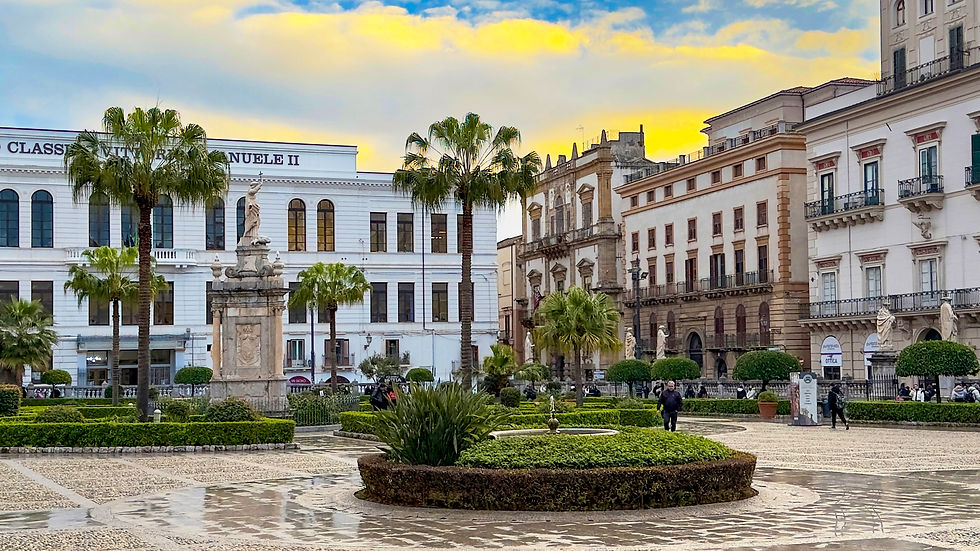
Morning in Palermo.
Palermo does none of that. It simply shows up as Palermo, with a boisterous take-it-or-leave-it confidence. And somehow, without trying, that authenticity has become the draw. People don’t come here for perfection. They come for truth. They come for a city that feels alive, messy, complicated, and real. Whether this was intentional or not doesn’t really matter. What matters is that Palermo never turned away from itself in order to be liked.
That takes a certain kind of confidence, or perhaps a kind of indifference. Either way, it works.

A view from the top of the Palermo Cathedral.
There is a beautiful paradox at the heart of Palermo. The city is rough around the edges. It’s loud, chaotic, and at times overwhelming. And yet, when all of those qualities come together, something unexpected happens. The city becomes welcoming. It becomes charming. It becomes full of warmth, exuberance, and joy.
Individually, some of Palermo’s traits might push people away. Taken together, they create something magnetic. The sum is far greater than the parts. We felt at home here, not because the city was easy or refined, but because it was honest and alive. Palermo doesn’t pretend. It doesn’t apologize. It doesn’t curate itself for outside approval.

One of the old city gates at the entrance to the city.
In a world where so many places feel increasingly manufactured, Palermo’s authenticity feels like a gift. It reminds you that beauty doesn’t always arrive polished and tidy. Sometimes it arrives loud, imperfect, and a little unruly. And sometimes, that’s exactly what makes it beautiful.
Palermo may not be for everyone, and that’s precisely why it works.

Enjoying one of Palermo’s finest treats, a cannoli perfected and made famous here.


kèo bóng đá hôm nay mình thấy mọi người nhắc hoài nên tò mò bấm vào xem thử giao diện thế nào. Mình không có ngồi soi nội dung hay chọn trò gì cả, chỉ lướt qua để xem họ sắp xếp thông tin ra sao thôi. Cảm giác đầu tiên là bố cục khá dễ nhìn, các mục được gom theo nhóm rõ ràng nên mới vào cũng không bị ngợp. Mình thích kiểu họ trình bày dạng khối với danh sách ngắn, nhìn phát là biết chỗ nào cần bấm, không phải mò nhiều. Menu cũng để ở vị trí dễ thấy nên chuyển qua lại giữa các phần khá nhanh, nhất là khi đang xem trên điện…