
Dubrovnik is Gorgeous, But . . .

Updated: Mar 19

Last week, Carla and I spent three days in Dubrovnik, Croatia, a place we had long wanted to visit. And Dubrovnik is undeniably beautiful. Nearly every blog post or review about it is glowing, and it is easy to understand why. Its setting on the Adriatic is stunning, the old stone streets are striking, and the famous city walls are among the most intact and impressive in Europe, perhaps even the world. Walking those walls and looking out over the sea and the terracotta rooftops was a memorable experience. It is easy to see why so many people are drawn there.

And yet, after taking in all its beauty, I was left with a nagging question: What happens to a place when tourism becomes the main organizing force? What do the people who actually live there lose? And over time, does that shift slowly wear away the very culture that made the place so fascinating to visit in the first place?
That was very much my feeling about Dubrovnik.

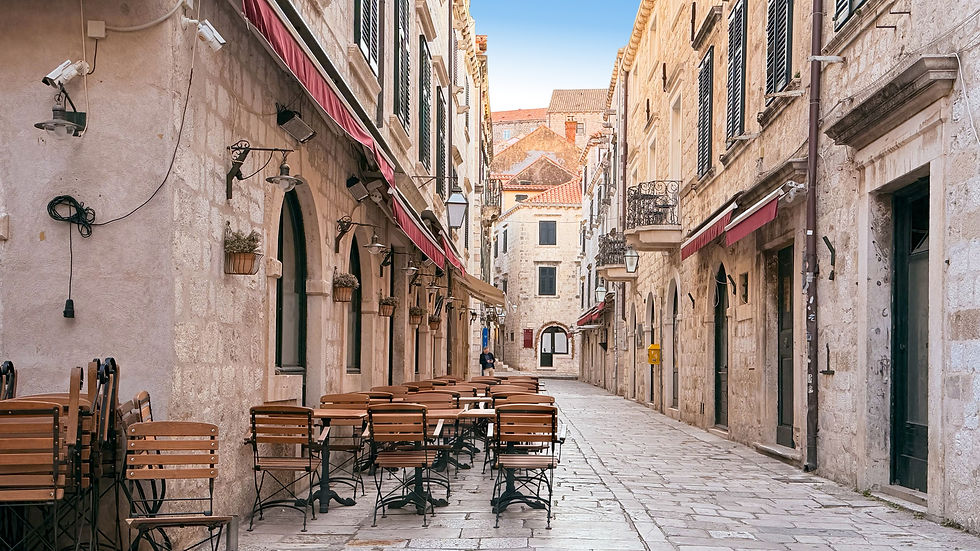
For me, Dubrovnik felt almost too polished. It was undeniably beautiful, but so carefully preserved and presented that it felt shaped more for visitors than for everyday life. Instead of feeling like a living town, it often felt more like a museum. Impressive and stunning, yes, but also a little removed from real life.
Part of that feeling comes from the fact that only about 500 local residents still live in the old town. Once you know that, it explains a great deal. We walked those gorgeous streets and admired the buildings, alleys, squares, and views, but we never really felt the pulse of local life. We did not get much sense of Dubrovnik’s everyday culture. The old town now seems to exist almost entirely for tourism, and most of the people you encounter there are either visitors or people working in the tourism economy.

For Carla and me, what we love most about travel is not just seeing beauty. We love getting a feel for the life of a place. We find that in hearing the local language around us, noticing daily routines, seeing how people move through their town, finding cafes where life unfolds naturally, and knowing that we are somewhere real and inhabited. That is what gives a place its soul. It is not just architecture or scenery. It is the human life within it.
In Dubrovnik, that soul was much harder to find.

Fortunately, we were there at a very good time. Since it was still the off-season, the city felt manageable and pleasant. We could walk comfortably, take in the views, and enjoy its beauty without fighting through huge crowds, and for that we were truly grateful. But even in this quieter season, it was easy to sense how much of the town is set up to serve visitors. It was also easy to imagine what Dubrovnik must feel like in peak season, when it becomes completely overrun. By all accounts, it turns into something of a zoo, packed wall to wall with tourists. I have no doubt that for many people it is still worth seeing, but I also suspect that in high season much of its grace and charm gets buried beneath the sheer weight of tourism.

It reminded me very much of Venice, another place that is undeniably gorgeous, and one I am so glad we saw. We were fortunate to be there in the off-season as well, and I remain deeply grateful for that. But in Venice, too, there was that same underlying feeling that we were not seeing much of the local culture. So much beauty, so much history, so much wonder, and yet also the unmistakable sense that the place has had to surrender too much of itself to accommodate the world’s desire to experience it. In both Dubrovnik and Venice, I found myself thinking not only about what we as travelers gain by being there, but also about what the people who actually live there may have lost in the process.

When tourism dominates, something precious is put at risk. The danger is not just crowding or inconvenience, though those are real enough. The deeper risk is that a town begins to lose what made it attractive in the first place: its texture, its rhythm, its daily life, its local character, its authenticity, its soul.
That may sound dramatic, but I do not think it is. Places are not beautiful only because of stone streets and scenic views. They are beautiful because they are alive. Because people still live there, raise families there, buy bread there, sit in cafes there, laugh there, argue there, and grow old there. That is what gives a town its atmosphere and emotional depth. When too much of that disappears, beauty alone cannot replace it.

Dubrovnik is still extraordinary to look at. I understand why so many people love it. I am glad we went. I am grateful we walked the walls, wandered the streets, and saw it with our own eyes. But I also left feeling that it had become a place more admired than lived in. And for me, that makes the beauty feel a little bittersweet.
What worries me most is that Dubrovnik is not the only place facing this. We all see and hear about overtourism happening in many places, and we cannot really blame locals for wanting both to move out and to benefit from the tourism economy. But when a place begins to shape itself too much around visitors, something important starts to slip away. What remains may still look beautiful, but it begins to feel less real, less lived in, and less rooted in the local life that once gave it its character.

Because in the end, we are not drawn to these places only because they are beautiful. We are drawn to them because they feel alive. They feel human. We get to see and experience another way of life. If tourism dilutes that, then what is left may still be lovely to look at, but the essence that made it special, both for the locals and for us as visitors, begins to fade.

And who really knows how to balance all of this? I do not think the answer is to stop traveling. Travel has too much value, especially at a time when the world so badly needs greater openness toward people of different cultures, backgrounds, and nationalities. The more we encounter lives and places different from our own, the better that is for all of us. People will continue to travel, and beautiful places will always draw them. But overtourism is not some unstoppable force of nature. It can be mitigated if both travelers and local leaders are willing to think differently.
For travelers, maybe that means being more intentional. Staying longer. Traveling in the off-season. Supporting local businesses. And doing more research to find those beautiful, fascinating, and deeply rewarding places that have not yet been overrun. In many cases, those places will give you a richer and more authentic experience than the famous destinations that have been photographed, promoted, and Instagrammed to death.
And just as importantly, my hope is that cities and towns find a way not to surrender themselves entirely to the demands of tourism. Tourism brings money, of course, and that matters. But there has to be a healthy balance. Community does not have to lose to tourist revenue. Leaders can make choices that protect local life, preserve housing, and keep their towns livable for the people who actually call them home. In the long run, sacrificing the soul of a place is far too high a price to pay.
Because if we are not careful, we may keep loving these places in ways that slowly hollow them out. And what remains, however beautiful, will be missing the very life that made it worth visiting in the first place.


This is happening big time in Barcelona. The locals are using water pistols on tourists. I can’t blame them When I lived in Telluride in the 70’s I experienced this when the ski area opened and then the airport and then Hollywood types buying property. The locals were so divided about it all. I don’t know the answer but the government it seems has to help mitigate this
We were there about fifteen years ago and it was the cruise ships whose passengers clogged the streets from mid afternoon until five o’clock when they all vanished. We were able to find galleries and local shops by wandering off a bit which I am sure you did too. The setting is gorgeous. I am glad I have seen it.
Thanks for another great blog post, Simcha. It sounds like Dubrovnik is taking active steps to put some caps on cruise ships which are a huge problem. My first cruise in the 1990s was on the Norway which held about 2000 people. Now they are carrying 5000-7000 people which is insane.